
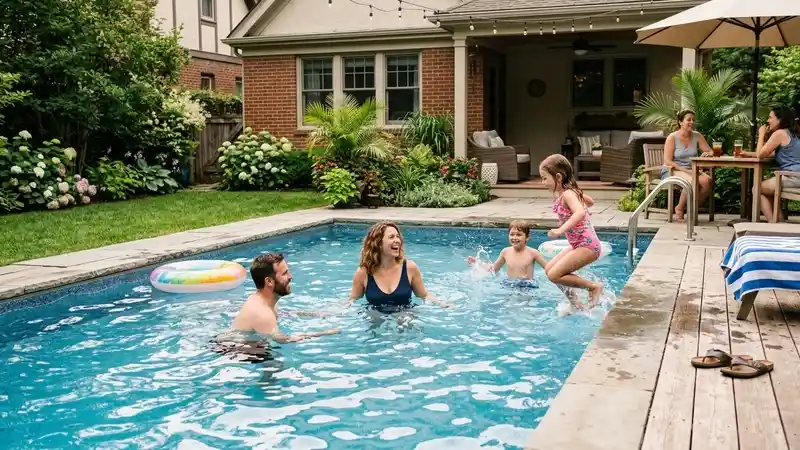
An above-ground pool has a reputation problem. It shows up in the backyard as a big blue circle with a corrugated wall, a ladder leaning against it, and a filter humming away in the grass — functional, fun, and unmistakably budget. But the pool itself is rarely the issue. What makes a setup look cheap is everything around it: exposed hardware, bare edges, mismatched plastic chairs, a hose snaking across the lawn. Fix the surroundings and the same pool starts reading like a designed feature instead of an appliance. Here’s how to do it on a real budget, with choices that survive humid summers and salt air.
Break Up the Wall Line
The biggest visual tell is the uninterrupted sweep of the pool wall. You don’t need a full wraparound deck to solve it — those run into five figures fast. A partial deck along roughly a third of the perimeter does most of the work: it gives you a proper entry point, retires the ladder, and interrupts the wall so the eye stops reading “tank.”
If a deck is out of reach, build up instead. Stacked pavers, a low retaining wall, or tiered planters along one arc create the same broken silhouette for a fraction of the cost. Composite or pressure-treated decking handles moisture far better than untreated wood, which matters for above-ground pools in Charleston backyards or above-ground pools for Lowcountry backyards, where humidity, afternoon storms, and salt in the air punish anything left raw.
Give It a Real Floor
Grass around a pool never stays grass. It goes patchy, then muddy, then bare. Replacing that
ring with a defined surface is the fastest upgrade in the entire project. Options, cheapest first: pea gravel or crushed shell with edging, rubber mulch, large-format concrete pavers on a compacted base, or a poured pad if you’re already renting equipment.
The trick is committing to one material and running it the whole way around. Gravel here, pavers there, and mulch in the corner reads as improvised. One continuous surface reads as designed.
Hide the Mechanical Sprawl
Pumps, hoses, chemical buckets, floats, and the vacuum head are what turn a backyard into a job site. Getting them out of sight is a same-afternoon fix. A screening panel of cedar slats or lattice around the pump costs under $100 and dampens noise. For everything else, an outdoor storage shed from Keter gives you a resin, weather-sealed home for chemicals and toys that won’t rust or rot in coastal humidity — and it anchors the side of the yard you weren’t using anyway.
Then coil the hose and mount it. Never leave it lying across the lawn.
Add Light at the Water Line
Nothing makes a pool look expensive faster than lighting, and nothing is cheaper to install. A magnetic or clip-on LED inside the wall turns the water itself into the focal point after dark. Outside the pool, low-voltage path lights or café string lights on posts create the enclosed, resort-style perimeter that daylight can’t.
Warm white, always. Color-changing lights on a loop are the fastest way to undo everything else you’ve done.
Buy Fewer, Better Textiles
Three matching loungers beat six mismatched ones. Pick a two-color palette — charcoal and natural teak, or white and deep green — and hold it across cushions, towels, umbrella, and planters. Cohesion is what luxury actually looks like, and it costs nothing but restraint.
Skip inflatable furniture entirely. Store cushions dry between uses, and they’ll last three seasons instead of one.
Keep the Water Genuinely Clear
No amount of decking rescues cloudy water. Test twice a week in peak season, run the filter 8–12 hours a day in summer heat, brush the walls weekly, and empty the skimmer basket. Clear water looks expensive; green water can undo a $2,000 deck.
Frequently Asked Questions
What’s the cheapest change with the biggest visual impact? Defining the ground surface around the pool. Gravel or pavers with clean edging typically runs $200–$600 for a standard round pool and eliminates the mud ring that makes any setup look temporary.
Do I need a permit to build a deck around an above-ground pool? In most South Carolina municipalities, yes. Decks above a certain height and any structure attached to a pool generally require a permit plus a barrier that meets code. Confirm with your county building department before buying materials.
How long does an above-ground pool last in a coastal climate? A quality steel-wall pool typically lasts 7–15 years with consistent maintenance, and liners usually need replacing every 5–9 years. Rinsing salt residue off the wall and hardware extends both.
The goal isn’t disguising the pool. It’s finishing it — edges, screening, light, and a consistent palette. Handle those four things and the gap between a $3,000 setup and a $30,000 one narrows to something most guests will never notice.
If you get more details for home cleaning, home interior, home designs so click here