
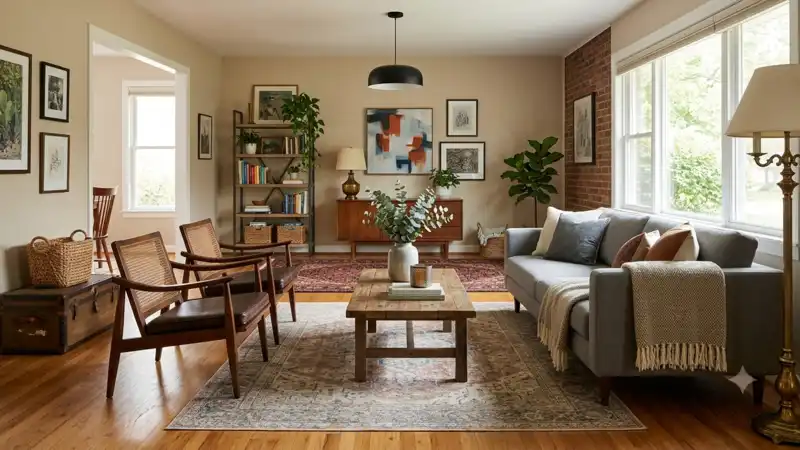
A beautiful room doesn’t always come from choosing one decorating style and sticking to it from floor to ceiling. In fact, some of the most interesting interiors are built around contrast. A vintage cabinet beside a modern sofa, a rustic wood table under a contemporary light fixture, or traditional artwork against a simple wall can give a room personality that a perfectly matched furniture set simply cannot.
The challenge is knowing where to stop. Mix too many colors, materials, shapes, and design influences without a clear connection, and the room can quickly feel cluttered rather than collected. Instead of looking thoughtfully layered, it may seem as though you chose every piece independently.
The good news is that mixing décor styles doesn’t require professional design skills. What matters most is finding visual relationships between different pieces. Once you understand how color, proportion, texture, repetition, and scale work together, you can combine very different styles while still creating a room that feels comfortable and intentional.
Start With One Style as Your Foundation
Mixing styles doesn’t mean every style needs equal attention.
One of the easiest ways to create balance is to choose a primary style for the room and allow one or two other influences to complement it. Think of the main style as the foundation rather than a strict rulebook. For example, you might build a living room around a modern aesthetic with clean-lined furniture, neutral walls, and simple lighting. From there, you could introduce a vintage wooden coffee table and a few traditional decorative pieces.
Alternatively, a farmhouse foundation could incorporate industrial lighting or contemporary artwork without losing its warm character.
The mistake is often trying to make several styles compete for attention. If you have a modern sofa, a traditional dining table, a bohemian rug, an industrial bookshelf, ornate lighting, and heavily patterned curtains, the room may lack a visual hierarchy. Choose what will dominate, then decide which other styles deserve supporting roles.
Find a Common Thread
Different styles become much easier to combine when they share something. That “something” could be a color, material, shape, finish, or even a particular mood.
Imagine a room containing a mid-century modern chair, a rustic wooden bench, and a contemporary metal lamp. At first glance, those pieces belong to different design traditions. But if the room uses warm wood tones throughout and repeats black accents in several places, they begin to feel connected. This is one of the simplest principles to remember:
The pieces don’t have to match. They need to relate.
Color is particularly useful for creating that relationship. If you introduce a strong terracotta shade through a rug, repeating that color in a cushion, artwork, or small decorative object can make the room feel cohesive. The same approach works with materials. A wooden coffee table, woven basket, and timber-framed artwork can quietly connect otherwise different furniture styles.
Let Color Do Some of the Organizing
Color can either bring a mixed-style room together or make it feel chaotic. You don’t need to limit yourself to three colors, but it helps to establish a general palette before adding too many decorative elements.
A neutral base is often useful because it gives contrasting pieces room to breathe. Cream, beige, soft gray, white, muted green, and other understated shades can create a backdrop for stronger furniture and accessories.
That doesn’t mean your room has to be boring. A neutral room can become much more expressive through carefully selected accent colors. If you love deep blue, for instance, you could introduce it through a rug, a piece of artwork, and a few cushions rather than using a different accent color for every object.
Repetition makes the difference. When a color appears in several areas of the room, the eye begins to recognize it as part of the overall design rather than an isolated statement.
Pay Attention to Scale and Proportion
Two beautiful pieces can look completely wrong together if their proportions don’t work. Consider a large traditional armchair next to an extremely delicate contemporary side table. Neither item is necessarily unattractive, but their different visual weight may make the pairing feel awkward.
Scale matters, especially when combining styles, because different design traditions often use different proportions.
Before buying something new, look at the furniture already in the room. Is it visually heavy or light? Are the pieces mostly low and horizontal or tall and vertical? Are the shapes compact, oversized, delicate, or substantial? Then look for balance. A large vintage cabinet might work beautifully with a streamlined modern sofa because the sofa’s simplicity keeps the cabinet from overwhelming the space. Similarly, an ornate mirror can become a focal point when surrounded by relatively simple furnishings.
You don’t need everything to be the same size. You just need enough variation to create interest without letting one piece make everything around it look insignificant.
Mix Materials, Not Just Styles
One reason eclectic rooms can feel rich rather than messy is that they contain a thoughtful mixture of textures. Wood, metal, glass, stone, linen, wool, leather, cotton, and woven materials all interact differently with light and touch. Combining them can make a room feel layered even when the color palette is restrained.
For example, a contemporary room with a glass coffee table and smooth upholstery might feel somewhat cold on its own. Adding a textured wool rug, a wooden stool, woven storage baskets, and linen curtains can introduce warmth without changing the overall style.
The same principle works in reverse. A room dominated by rustic wood can benefit from polished metal, glass, or smooth modern surfaces. The contrast prevents the space from becoming visually predictable. Texture is especially useful when you want to mix styles but don’t want to introduce lots of additional colors.
Use Contrast Intentionally
Contrast isn’t the enemy. Random contrast is. A dark industrial lamp over a light traditional dining table can be striking because the difference is intentional. A sleek contemporary chair beside an antique cabinet can create an equally interesting relationship.
The key is to make the contrast look like a choice. One useful approach is to repeat the contrasting element elsewhere. If you introduce black metal through a light fixture, perhaps bring a little black into the picture frames or furniture hardware. If you add a vintage piece with distressed wood, repeat warm wood tones somewhere else.
This creates a subtle conversation between the objects. Instead of thinking, “Do these pieces match?” ask, “What connects these pieces?” That small change in thinking can completely alter how you approach decorating.
Don’t Forget the Walls and Lighting
Furniture usually gets most of the attention, but walls and lighting have a major influence on whether mixed styles work. Artwork can bridge design differences surprisingly well. A contemporary painting may sit comfortably above an antique console because the artwork introduces a modern element without requiring the rest of the room to change.
Gallery walls can also combine photographs, prints, paintings, and decorative objects, provided there is some consistency in framing, color, subject matter, or arrangement. Lighting deserves the same consideration.
You could have a traditional table lamp, modern ceiling fixture, and industrial floor lamp in one room. They don’t need to belong to the same design family, but their finishes, proportions, or placement can create enough connection to make the combination feel deliberate. And don’t underestimate the effect of warm versus cool light. The right lighting can soften materials and colors that might otherwise feel disconnected.
Create a Visual Plan Before You Start Buying
One of the easiest ways to avoid decorating mistakes is to visualize the room before committing to purchases. Gather photographs of furniture, rugs, artwork, colors, and accessories that appeal to you, and place them together digitally or on a physical mood board. Seeing everything at once often reveals problems that are difficult to notice when you’re looking at individual products.
A collection of beautiful objects can still create an overwhelming room when viewed together. You can also create simple visual sequences to compare different arrangements. For example, a homeowner considering several furniture combinations might use a GIF maker to create a quick before-and-after sequence showing different décor arrangements. It doesn’t have to be sophisticated; the purpose is simply to make the design decision easier to visualize. This approach is particularly useful if you’re decorating gradually. Instead of buying items whenever you find something you like, you can check whether each new piece contributes to the room’s overall direction.
Give Statement Pieces Room to Breathe
Every room needs personality, but personality doesn’t mean filling every available surface. If you have a striking antique mirror, unusual chair, colorful rug, or dramatic piece of artwork, let it have some breathing room.
When every object is competing to become the focal point, none of them gets the attention it deserves. A useful way to think about this is to create visual pauses. Leave some shelves partially empty. Avoid placing large decorative objects immediately beside several other attention-grabbing pieces. Give an unusual piece enough surrounding space that its shape and character can be appreciated.
This is particularly important when mixing styles because eclectic interiors already contain more visual variation than highly uniform spaces. Negative space helps control that variation.
Let Your Personality Guide the Final Choices
Rules can help, but your home should still feel like your home. Perhaps you inherited a wooden cabinet from a relative. Maybe you found a modern chair you love while traveling. Perhaps your favorite artwork doesn’t fit neatly into the style you’ve chosen for the rest of the room.
You don’t have to remove everything that doesn’t fit a predefined aesthetic. Personal objects are often what make an interior feel authentic. The goal is not to create a showroom where every object appears to have been purchased at the same time. A well-designed home can show different periods, influences, and interests while still feeling cohesive.
If an unusual piece has personal meaning, look for ways to connect it with the surrounding décor through color, placement, or repetition rather than automatically rejecting it.
Know When the Room Needs Less
Sometimes the best design decision is subtraction. If a room feels chaotic, don’t immediately assume you need more matching furniture to fix it. You may simply have too many competing elements.
Stand in the doorway and look at the room as a whole. Which objects immediately attract your attention? Are there several areas competing for focus? Is there a color that appears only once and feels disconnected? Are the surfaces crowded? Try temporarily removing a few accessories.
You may be surprised by how much calmer the room feels. This doesn’t mean minimalism is always better. It means every object should have enough space to contribute to the room rather than getting lost among dozens of other visual signals.
Build the Room Gradually
One of the biggest advantages of mixing décor styles is that you don’t have to complete everything in a single weekend. Start with the larger pieces. Establish your sofa, bed, dining table, or other major furniture. Then introduce a rug, lighting, curtains, and artwork. Accessories can come later.
Living with a room for a while can tell you more than a rushed shopping trip ever will. You might discover that the corner needs a taller lamp, that the coffee table is too large, or that the room needs another warm material to balance the cooler surfaces. Decorating gradually gives you the opportunity to respond to the actual space instead of trying to predict everything in advance.
Conclusion
Mixing décor styles successfully isn’t about following a strict formula or making every piece coordinate perfectly. It’s about creating relationships between things that might initially seem different. Choose a foundation, establish a consistent color direction, pay attention to proportion, repeat materials and accents, and use contrast deliberately. Most importantly, give your favorite pieces enough space to stand out.
When different styles share a visual thread, they stop looking like unrelated choices and start feeling like parts of the same story. Your home doesn’t need to belong to one design category. It simply needs to feel intentional, comfortable, and genuinely yours.